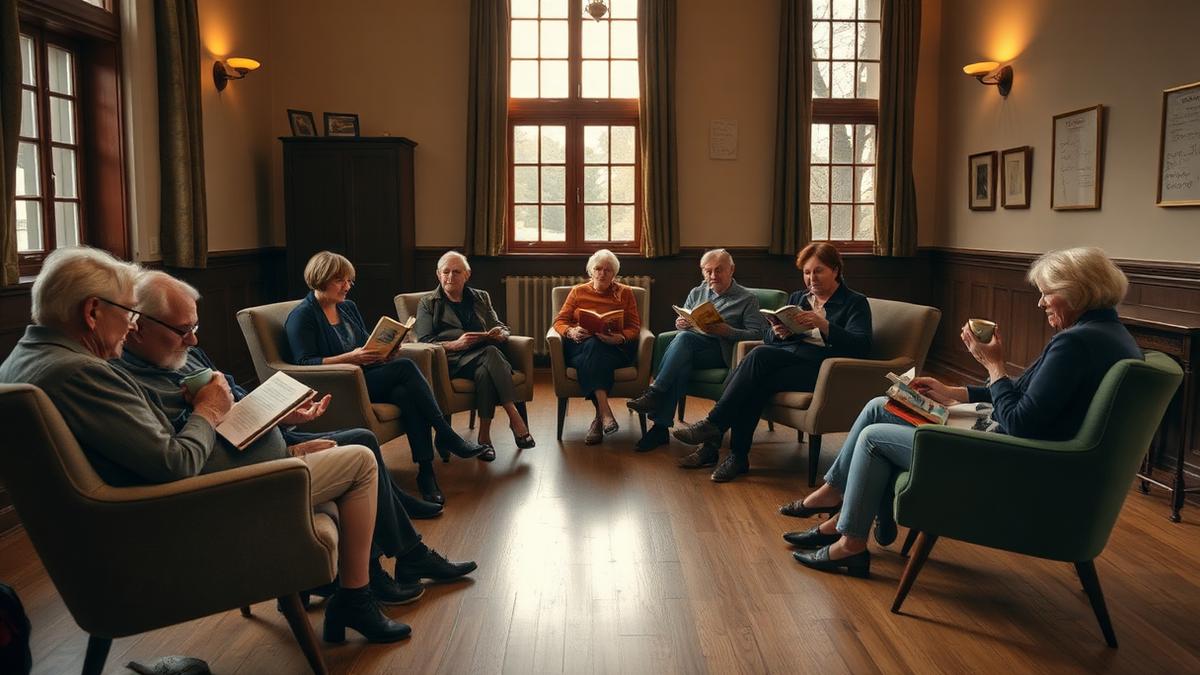
Nobody joins a reading community because of a poster. They join because someone they half-know said "come along on Thursday, it is only an hour." This is a field guide to making that Thursday exist.
The idea of a third place
Sociologists use "third place" for the spaces that are neither home nor work: the barber shop, the allotment, the corner pub. Reading is usually a first-place activity, done alone under a lamp. The odd thing is how much better it gets when you give it a third place, even for sixty minutes a fortnight.
A reading community is not an event. It is a habit with a postcode.
Where UK groups actually meet
- Back rooms of pubs. Free, warm, and landlords like a quiet midweek table. Ask for the slot nobody wants: Monday or Tuesday, 7pm.
- Independent cafes near closing. Many will let you stay after the last coffee if you all buy something.
- Community centres and village halls. Cheap by the hour, usually bookable online, and step-free.
- Libraries. Still the most underused option. Staff often help promote you for free.
- Outdoors. Silent reading in a park, phones away, one hour, then a drink. Wildly effective in summer.
Six weeks from nothing to a group
- Week one. Pick the slot and the venue before you pick a book. Time and place beat taste every time.
- Week two. Invite five people directly, by message, not by broadcast. Two will come. That is a group.
- Week three. Choose something short and cheap so nobody has to gamble twenty pounds on a hardback. Pre-loved copies keep the barrier at pocket money.
- Week four. Meet. Talk for twenty minutes about the book and forty about everything else. This is normal and good.
- Week five. Fix the next date before you leave the room. Never leave scheduling to a group chat.
- Week six. Ask each person to bring one other human. Growth is a chain of small favours.
Silent book club: the low-effort format
If the thought of hosting a discussion makes you tired, run a silent one. Everyone arrives with their own book, reads for an hour with no talking, then chats for half an hour about whatever they read. There is no homework, no reading pace, and nobody feels caught out. It is the easiest reading community to start and the hardest to kill.
The things that quietly break groups
- Books nobody can get hold of cheaply.
- A host who does all the work and burns out by month four.
- Moving the date. Once is fine. Twice ends it.
- Nobody saying they did not finish it, so everyone pretends.
What good looks like after a year
Twelve meetings. A shared shelf of battered paperbacks that have been round the whole group. Two friendships you would not otherwise have. A local bookshop or charity shop that knows your faces. That is the whole prize, and it costs almost nothing.
If you are setting one up, a rotating pile of second-hand copies is the cheapest engine you can give it. Pass books on rather than buying twelve new ones: good for your pocket, good for the planet.
What the host actually does
The word "host" makes people imagine catering and clever questions. In practice the job is three small administrative acts: hold the date, tell people the date, and turn up first. Everything else is optional. If you can send one message a fortnight and arrive ten minutes early to grab a table, you are qualified. Groups fail from admin fatigue far more often than from a lack of interesting opinions, so the whole design goal is to keep the host's job small enough that nobody dreads it.
Split the work as soon as you have four regulars. One person owns dates and reminders, one owns the venue, one owns the book list. Three people doing a fifteen-minute job each is durable. One person doing a forty-five-minute job each month is a countdown to the end of the group.
Making a newcomer's first night easy
The most fragile moment in any reading community is a stranger standing in a doorway wondering if they are in the right place. Fix that with dull, practical things:
- Say the exact table, not just the venue. "Back room, left of the bar" removes most of the anxiety.
- Tell them they can come without having read anything. Half your future regulars will start this way.
- Name one person they will meet. Turning up to meet a person is much easier than turning up to meet a group.
- Give an end time. People commit to ninety minutes far more readily than to an open evening.
Once someone has come twice, they belong. Getting to the second visit is the entire challenge, and it is almost always solved by clarity rather than charm.
How to talk about a book without an English degree
Discussion dries up when the conversation feels like an exam. Skip analysis and start with reaction: where did you put the book down, which character annoyed you, what did you skim. Those questions are answerable by anyone who read forty pages, which keeps the room honest and the quieter readers involved. Plot summaries are the enemy: everyone was there, and reciting the story eats twenty minutes that could have been an argument.
Community beyond the meeting
A reading group is a room, but a reading community is a small local economy. It grows when you attach it to things that already exist: a charity shop that keeps interesting stock aside, an independent bookshop with a noticeboard, a library that will list you for free, a cafe that likes a quiet midweek booking. Once three or four of those relationships exist, the group survives losing its founder, which is the real test of whether you built something.
The other half of that economy is the books themselves. A shared crate of second-hand paperbacks, passed along and never sold on at a profit, does more for a group than any reading list. One copy can serve six readers across a year, nobody is asked to gamble twenty pounds on a hardback, and the stack becomes a small piece of shared history: annotations, coffee rings, someone's train ticket used as a bookmark.
A realistic first year
Expect three or four regulars, a couple of cancelled nights, one book everyone hated and enjoyed hating, and a slow drift towards shorter picks. That is not a failing version of a book club. That is what a working one looks like. The groups that last are not the ambitious ones with reading schedules and spreadsheets, they are the ones that meet slightly more often than they should be able to, on a fixed night, with cheap books and low expectations.