This week, Britain's airports stopped working properly. A fault in the flight processing system at Nats, the UK's air traffic control provider, began at around 1pm on Tuesday and took almost four hours to fix. By Wednesday evening, analysts at Cirium counted close to 2,100 cancelled flights in and out of UK airports. British Airways alone scrapped nearly 550 services affecting more than 85,000 customers. Ryanair cancelled over 250. Heathrow, Gatwick, Manchester, Stansted, Birmingham, Edinburgh and Belfast were all caught up in it.
The Transport Secretary summoned the Nats chief executive. Airline bosses called for resignations. There will be an investigation, and a cyber attack has already been ruled out. All of that matters, and none of it is our field.
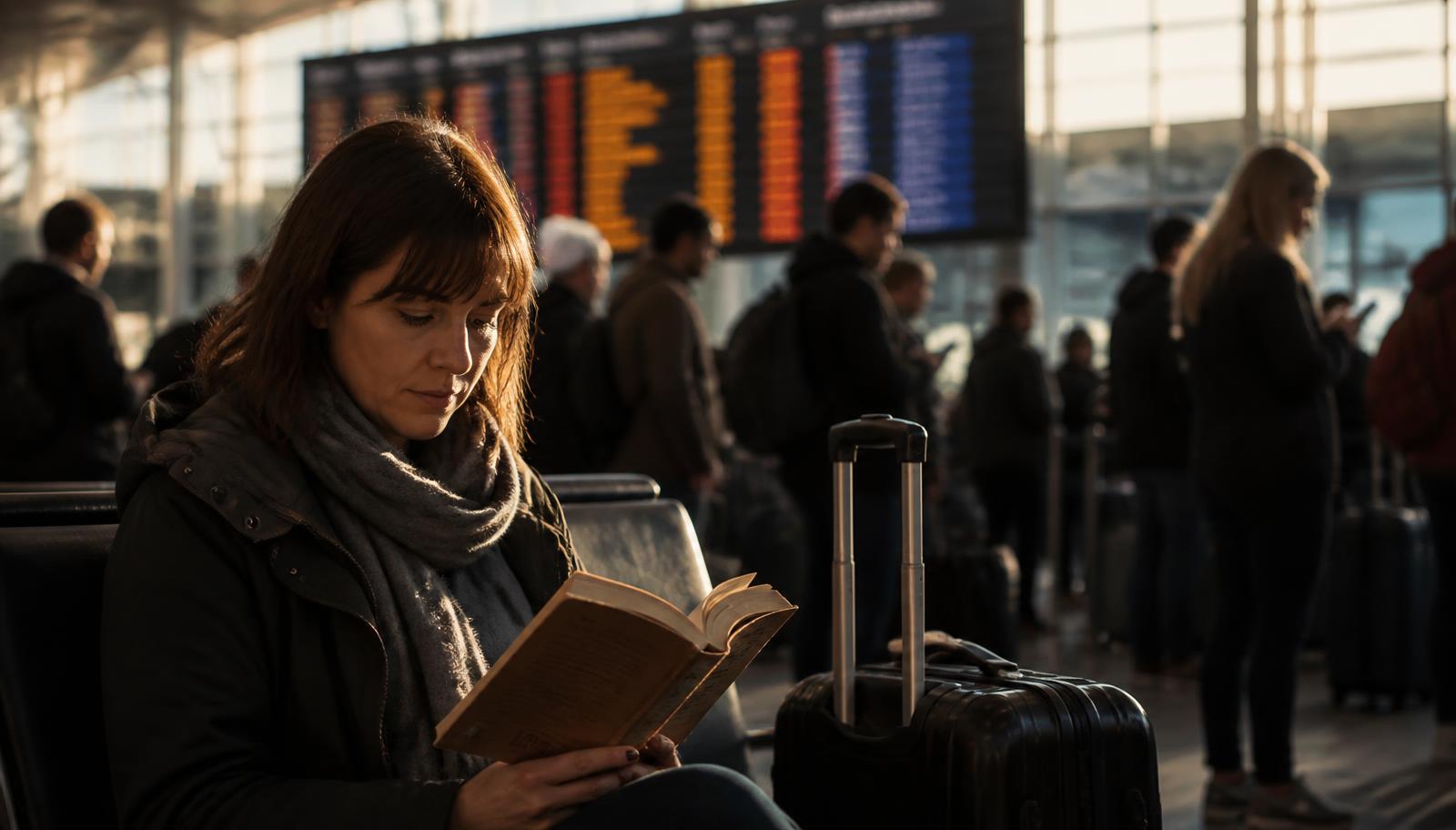
What we noticed was something smaller and stranger. Somewhere between the departure boards and the queue for the customer service desk, thousands of people suddenly had eight, ten, fourteen unplanned hours with absolutely nothing to do.
And most of them spent it on their phones, refreshing.
The delay is the last honest empty hour we get
Modern life is very good at removing gaps. The commute has a podcast. The queue has a scroll. The five minutes waiting for the kettle has a notification. We have quietly filled in every crevice of the day, and then we wonder aloud why we never seem to have time to read.
An airport delay is one of the few remaining situations where the gap simply cannot be closed. You cannot work properly. You cannot go home. You cannot do the washing up or answer the door or start a job you would have to abandon in twenty minutes. You are stuck in a chair with a rolling suitcase against your leg, and the only real question is what you do with your own attention.
People who had a book in their bag on Tuesday had a very different day from people who did not.
We are not being glib about it. Being stranded is miserable. Some of those passengers had funerals to get to, connections to make, children who needed feeding, and a battery at nine per cent. A paperback does not fix a cancelled flight. But when the situation is entirely out of your hands, the difference between grim endurance and a tolerable afternoon often comes down to whether you have something to disappear into.
A phone is a bad tool for that job, and it is bad in a specific way. It keeps offering you the thing you are trying to escape. Every refresh brings another update about the outage, another airline apology, another stranger's queue photo. Anxiety and information look identical on a small screen, and after four hours of it you are more frayed than when you started, with a dead battery to show for it.
Why a book is the correct piece of travel equipment
There is a practical case for the printed book that has nothing to do with nostalgia.
It has no battery, which matters enormously when 2,000 flights have gone and every plug socket in the terminal has three people standing around it. It works in the queue, on the coach to the diverted airport and in the seat you eventually get at 11pm. It does not need signal, and it does not need the terminal wi-fi that collapses the moment everybody needs it at once. It cannot buzz at you. It has no comment section.
Most usefully, it does something a screen genuinely struggles to do: it holds a single line of attention long enough that an hour passes without you noticing. That is not a small trick when you have ten hours to lose.
The reason more of us do not carry one is rarely principle. It is cost and clutter. A new paperback at ten or twelve pounds is a real decision, and nobody wants to pay that for a book they will read once in a departure lounge, particularly if it turns out to be dull by page forty. So the book stays at home, and the phone comes out.
That is precisely the problem second-hand books solve. When a paperback costs two or three pounds, it stops being an investment and becomes what it should be: something you throw in a bag. You can carry two. You can abandon one at page thirty without guilt. You can leave a finished book on a shelf in the hotel for the next person, which is a very old travellers' custom and a good one.
What actually survives a delay
Not every book works in a terminal, and it is worth being honest about which ones do.
The things that hold up are books with a strong forward pull and short chapters: crime and thrillers, big commercial suspense, adventure, page-turning historical fiction. Chapter breaks matter more than you think when you are being interrupted every twenty minutes by an announcement. Short stories and essay collections are underrated for the same reason, because you can finish a whole piece between one tannoy and the next.
Comfort reading also earns its place. A reread of something you already love asks nothing of you and gives a great deal back, which is exactly the ratio you want when you are tired and cross. Travel writing works well too, in a slightly perverse way, because it lets you go somewhere while you are demonstrably going nowhere.
The things that struggle are dense literary novels with two hundred characters, anything requiring a notebook, and grief-heavy memoir. A departure lounge at midnight is not the moment for a difficult book. Save it.
Children need their own version of this. Two thin, familiar books beat one long unfamiliar one, and a picture book you can read aloud three times will buy you more peace than any tablet on eleven per cent.
The small resolution worth taking from a bad week
By the weekend the flights will be moving again, the investigation will grind on, and most of us will forget the whole thing until the next time. Nats has now had a technical failure of some kind in 2023, in 2025 and again this week, so it would be optimistic to assume there will not be a next time.
The useful takeaway is not a lecture about screens. It is a habit that costs about three pounds. Keep a cheap second-hand paperback in the bag you travel with. Not a special book, not the one you are saving. A blunt, gripping, entirely disposable one. It will sit there doing nothing for months, and then one Tuesday afternoon a system nobody has heard of will fail, and it will be the most useful thing you are carrying.
Britain lost roughly 2,100 flights this week. A quiet number of people lost the afternoon far more gracefully than the rest, and almost all of them had something in their hand that did not need charging.
ReReadz is a UK marketplace where readers buy and sell pre-loved books directly with each other. There are hundreds of paperbacks under five pounds, which makes stocking a travel bag considerably less painful. Tracked delivery starts at £2.99.